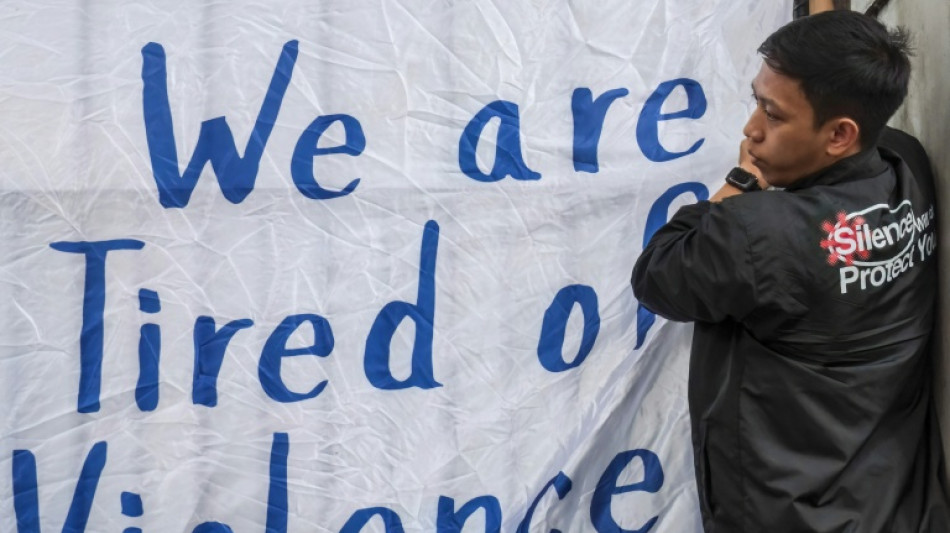
Acid attacks highlight growing danger for Indonesian activists / Photo: © AFP

Indonesian environmental activist Muhammad Rosidi shudders as he recalls the horrific moment two men on a motorbike threw acid through the open window of his car as he was driving on Sumatra island in February.
He was instantly consumed by a burning pain as the corrosive liquid ate into his hands, legs and groin.
"I knew right away it was acid. It felt like being doused in boiling water," the 43-year-old told AFP.
No arrest has been made weeks after the attack that Rosidi is convinced was triggered by his campaigning against illegal tin mining and smuggling in the Bangka Belitung islands off Sumatra.
He is one of an increasing number of activists and government critics rights groups say are being targeted in ever-more vicious attacks in the world's third-largest democracy.
The latest victim was 27-year-old Andrie Yunus, an activist from the KontraS human rights group who risks losing vision in one eye after two men on a scooter threw acid at him while he rode a motorbike in the capital Jakarta last month.
In an environment Amnesty International described this week as "rife with repression of dissent", protesters, journalists and even academics are also coming under threat.
"After the attack on Andrie, the threats actually increased... also death threats," Bhima Yudhistira Adhinegara, executive director of the CELIOS economic think tank, told AFP of his own experience.
He is being targeted for critiquing government programmes including President Prabowo Subianto's signature school feeding scheme, a major budget outlay.
A stranger recently texted Bhima to say that his name had appeared on the same hit list as Andrie's.
"We've been stepping up security... adding more CCTV and body protection. When going out, we don't go alone, we travel in pairs," he said.
- 'Hostility to criticism' -
Activists and observers say a climate of repression is taking root under a government that baulks at criticism under the leadership of ex-general Prabowo -- himself accused of human rights violations in the 1990s. He was never convicted, and he denies the accusations.
Andrie had been a vocal critic of what many perceive as the military's expanding role in government, and was attacked shortly after recording a podcast on the topic.
"We cannot separate the growing attacks on activists from the broader context of the current government's hostility to criticism," Amnesty International Indonesia spokesman Haeril Halim told AFP.
In a report this week, Amnesty said nearly 300 human rights defenders suffered intimidation or violence in Indonesia in 2025.
During mass anti-government riots last August, more than 4,000 people were arrested, it added, with hundreds assaulted by police and 10 civilians killed.
The media has also come under fire, with the Tempo media outlet receiving a rotting pig's head and six decapitated rats at its office last March in an apparent warning to stop asking uncomfortable questions.
"Attacks on critical civil society groups fighting for human rights are happening because democracy in Indonesia is steadily regressing," Arif Maulana, a human rights lawyer with the Indonesian Legal Aid Foundation, told AFP.
"The methods used... have become very serious threats to people's safety and lives," he said.
For Amnesty International Indonesia chief Usman Hamid, Indonesia "will truly become an authoritarian country if left unchecked".
The government denied claims of repression and said it welcomed criticism as "a valuable form of public participation that ensures the governance process runs smoothly".
Kurnia Ramadhana, a senior legal adviser in the Government Communications Office, pointed AFP to a recent poll by the Indonesian Survey Institute which found a vast majority of respondents were satisfied with the functioning of democracy and freedom of expression.
"Essentially, according to scientific data, the repression phenomenon, as found by Amnesty, is not proven," he said.
- 'Terrorism' -
The attack on Andrie sparked global outrage and calls for an independent investigation amid widespread fears of a cover-up in a country where such crimes are rarely punished.
Four military intelligence officers were arrested and the agency's chief resigned without his alleged role in the crime being disclosed.
Activists say the decision to try the four soldiers in a military court without the possibility of public scrutiny bodes ill for the pursuit of justice.
Kurnia insisted Prabowo was "making every effort to eliminate impunities for the perpetrators, even those from the military" in the Andrie case.
The choice of acid as a weapon, said University of Indonesia criminologist Adrianus Meliala, is meant to send a message not only to the victim but also to warn others.
"Acid always leaves scars," he told AFP.
Rosidi still has nightmares and struggles with recurring infections, but he insists he will not be deterred.
"If no one is critical, who will care about our environment and our country?" he asked.
W.Schubert--NRZ