Thousands march to demand illegal migrants leave South Africa / Photo: © AFP

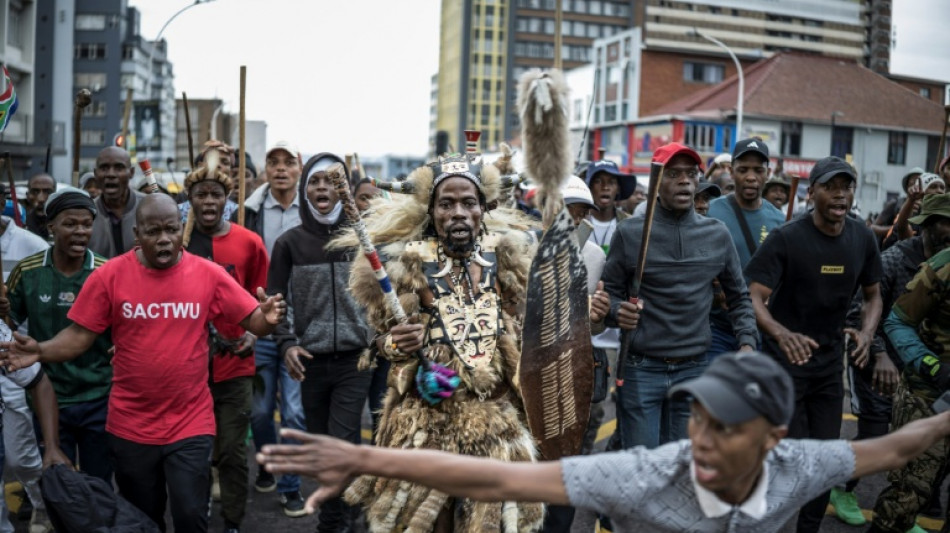
Thousands of people marched Tuesday in cities across South Africa to demand the departure of undocumented foreign nationals after a weeks-long campaign that has sent thousands fleeing and claimed four lives.
The nationwide protests cap growing demonstrations called by a loose coalition of minor political parties and small citizen-led vigilante groups that set an unofficial June 30 deadline for foreigners without papers to leave.
A few thousand South Africans took to the streets in the centre of the financial capital Johannesburg, where most shops stayed shuttered, workers stayed home, and transport hubs were quiet.
They marched behind organisers, waving flags and placards and watched by police in bulletproof jackets and riot helmets.
In the southeastern city of Durban, the Zulu heartland, protesters turned out in traditional warrior attire, carrying spears, whips and shields and some draped in leopard skins.
At least four armoured vehicles were stationed along the route, while a police helicopter hovered overhead, AFP reporters saw.
Brightness Gumbi, 48, who runs a kitchen business in a Durban township, said she joined the protest after years of struggling to secure an affordable place for her business.
"The illegal foreigners manage to pay it because they sell drugs to our people," she told AFP. "I hope through these demonstrations our president will hear our cries and enforce stricter laws."
In tourist magnet Cape Town, the turnout was far more muted with only about 100 people joining a march through the city centre and passing a counterprotest against Afrophobia and xenophobia.
Police said most of the protests across the country had been peaceful but they had responded to "isolated incidents of looting and attempted looting".
- 'I'm scared' -
One of the continent's wealthiest countries, South Africa is a magnet for migrant labour while grappling with an unemployment rate above 30 percent, high crime and a breakdown in services in many areas.
Coming ahead of local government elections in November, labour analyst Dale McKinley said the anti-migrant push has been "politically weaponised".
At least two Mozambicans, an Ethiopian and a Malawian have been killed in anti-immigrant violence over recent weeks and several African governments, including Nigeria, Malawi, Ghana, Zimbabwe and Mozambique, have organised voluntary repatriation flights and buses for their citizens.
More than 25,000 people had been processed for departure in recent weeks, South Africa's security forces said Monday.
As the protests unfolded, hundreds of migrants -- mostly Malawians and Zimbabweans -- gathered in Cape Town and Johannesburg, waiting for assistance to go home.
Some said their landlords had evicted them or their employers had fired them, fearing fines from officials or attacks by vigilante groups.
"I don't have work, that's why I came here," said a 23-year-old Zimbabwean woman in Cape Town, who had been in South Africa for six months and asked to remain anonymous.
"I want to go because how can I stay in South Africa? The people in South Africa, they don't want us here. I'm scared."
- 'Rolling mass action' -
The leader of the anti-immigrant March and March group, Jacinta Ngobese-Zuma, told reporters last week that Tuesday would launch "a national march to freedom, a rolling mass action" until all undocumented foreign nationals were deported,
"We are not calling for violence... No one will be killed on the 30th of June and no looting will take place in our name," she said.
Concerned about a repeat of the unrest that occurred five years ago, when around 350 people were killed in days of looting and riots, the government has ordered a massive security deployment and warned against opportunistic crime.
The July 2021 unrest was sparked by the brief jailing of ex-president Jacob Zuma for refusing to testify to a commission probing corruption.
In the countdown to June 30, President Cyril Ramaphosa announced stepped-up government plans to combat illegal immigration and called on traditional leaders to use their "standing to calm tensions".
The premier of KwaZulu-Natal province, Thami Ntuli, said: "Whatever our concerns about undocumented migration, however legitimate the frustrations beneath them, we will not allow this province to be set alight a second time, whether by criminality or by xenophobia."
But this is the first time that governments have simultaneously organised the repatriation of thousands of their nationals.
strs-jc-ho/br/cw
S.Schulze--NRZ