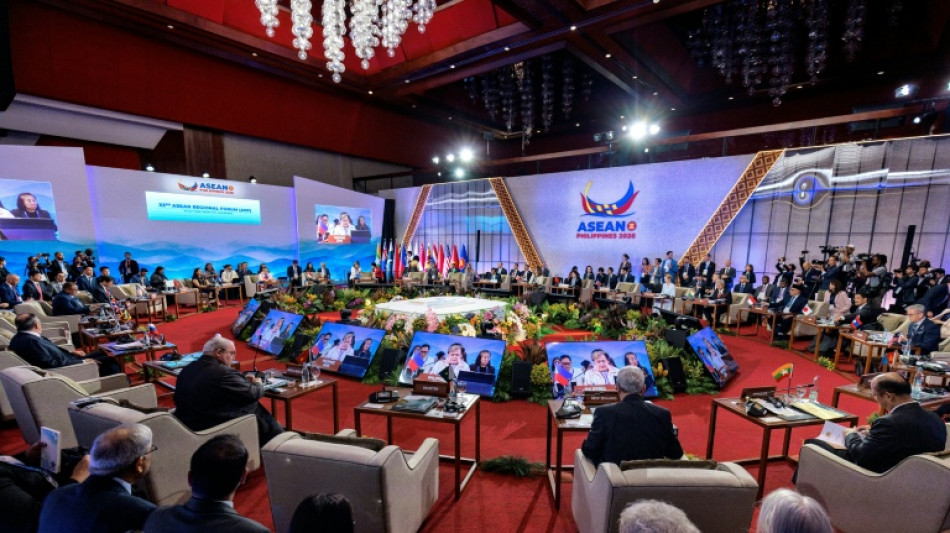
ASEAN calls for open straits as US-Iran war casts shadow / Photo: © POOL/AFP

Foreign ministers from fuel-stressed Southeast Asia called for freedom of navigation in international straits on Thursday as they wrapped a week of meetings largely overshadowed by the US-Iran war.
A joint communique issued at the Association of Southeast Asian Nations (ASEAN) gathering in Manila also repeated calls for self-restraint in a Middle East conflict that has carried economic ripple effects throughout the region.
Visiting US Secretary of State Marco Rubio this week warned ASEAN envoys that Iranian control of the Strait of Hormuz would set a "dangerous precedent".
"There is a fundamental principle about freedom of navigation that is threatened," he said.
The communique featured previously unused language targeting "freedom of navigation in and overflight above straits" while separately calling for "unimpeded" passage through the Strait of Hormuz.
The strait's closure following the joint US-Israeli strikes on Iran has left many in the region scrambling to deal with energy shortages and price spikes, with the import-dependent Philippines declaring a national emergency.
But while the communique alludes to energy cooperation among ASEAN states, no progress on previously announced initiatives like a regional energy grid or fuel-sharing scheme has been revealed.
Southeast Asia is itself home to two of the world's busiest shipping routes -- the Strait of Malacca and the Strait of Singapore.
- 'Political will' -
The meetings in Manila kicked off on Tuesday after a series of fresh clashes between China and the Philippines took place in the disputed South China Sea.
Despite the incident, Philippine Foreign Minister Theresa Lazaro told a closing press conference she believed both sides were focused on concluding the long-gestating agreement by years' end.
"This is now part of the political will, that we intend to finish this code of conduct at the end of the year," she said.
Earlier in the week, China's ambassador to Manila told reporters the recent clash at sea would have no effect on the push for a Code of Conduct for the crucial waterway.
"No matter what happened bilaterally, I think our willingness to finish the (code) talks at the end of this year has not changed," Ambassador Jing Quan said.
The pact will not, however, address bilateral issues like China's territorial disputes with the Philippines, Jing insisted, saying it would instead focus on "rules of engagement" for the waterway.
Analysts have long warned any document acceptable to both Beijing and ASEAN's member states would lack teeth.
Hours before Thursday's meetings concluded, the Philippine Coast Guard accused their Chinese counterparts of firing water cannon and using a "dangerous manoeuvre" to block vessels bringing aid to Filipino fishermen near a disputed South China Sea reef.
China said it had taken "necessary measures" to expel the Philippine vessels from its territorial waters.
L.Koch--NRZ