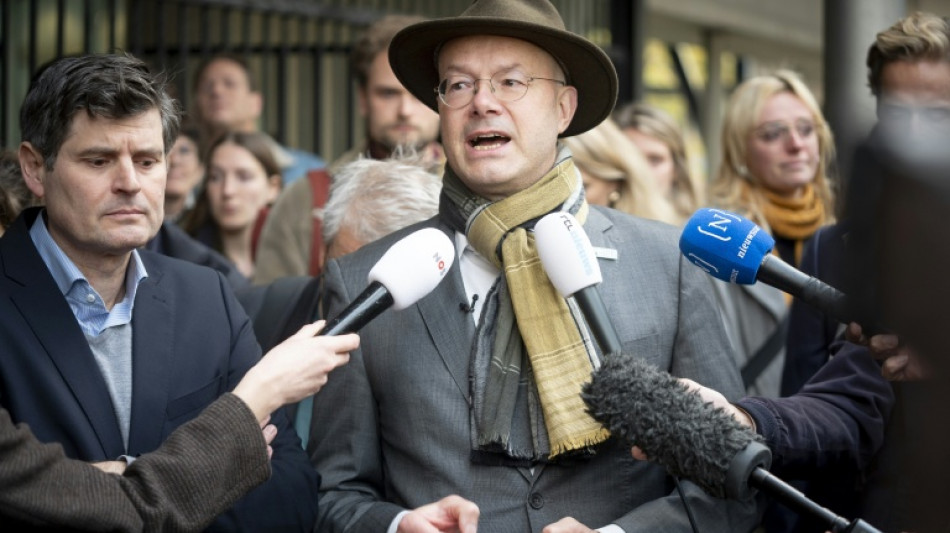
Pro-apartheid past of former boss roils Dutch climate group / Photo: © ANP/AFP

The Dutch climate pressure group that won a landmark court case against Shell has been plunged into turmoil after its boss jumped ship to Tata Steel, only to be sacked a day later over his pro-apartheid past.
Milieudefensie, the Dutch branch of Friends of the Earth, and its executive director Donald Pols made global headlines in 2021 with a legal victory over Shell when judges ordered the oil giant to slash carbon emissions -- a verdict later partially overturned and still being fought in the courts.
Pols has been front-page news recently in the Netherlands again, but this time at the centre of an extraordinary chain of events that culminated in the mass resignation of the group's supervisory board.
The saga began last month when Pols, a 54-year-old born in South Africa, dropped a bombshell announcement: he was leaving Milieudefensie after 11 years to join Tata Steel as director of sustainability and communications.
Pols described it as a "logical next step", arguing he could make the company more sustainable from within.
But critics wondered how a man who had pioneered the pressure group's strategy of targeting individual polluting companies could then end up working for one.
The head of Milieudefensie's supervisory board, Marty Smits, said: "We are surprised by Donald Pols' departure and very disappointed in his decision to join Tata Steel, one of the largest polluters in the Netherlands."
"We... have no understanding for Donald Pols' choice," said Milieudefensie, promptly sacking him as executive director.
Tata Steel Netherlands said they welcomed a critical eye on its activities.
"Donald has kept us on our toes for years and we are grateful to him for that," said Hans van den Berg, Chairman of the Board of Tata Steel Netherlands.
"We need people who continue to challenge us, even when it is uncomfortable. Donald is such a person."
- 'This is our country' -
Pols started his new job on June 1. He lasted one day.
On June 2, Tata Steel sent a shock statement sacking him.
"In recent days, it has become clear that additional information about his background has come to light, information that... was not previously shared with the company," said the firm.
The same day, Dutch daily NRC published a long tell-all interview in which it emerged that a 19-year-old Pols had led a far-right group called Afrikaner Studente Front (ASF) at the University of Pretoria.
At the time, in the early 1990s, the university was seen as one of the flashpoints in the fight over apartheid between conservative white Afrikaners and their liberal opponents.
According to NRC, the ASF employed Nazi symbolism and disrupted speeches by black South African leaders including Nelson Mandela.
The goal of the ASF was a homeland for white South African Afrikaners and to stop the Mandela-inspired anti-apartheid wave sweeping the country.
NRC cited a 1991 interview given by Pols to local media in South Africa in which he reportedly said: "This is our country, and we will not allow it to be taken from us in such a dictatorial manner."
"The only way to prevent a bloodbath is to give the Afrikaner a fatherland of their own," Pols was cited as saying.
His murky past emerged after historian Anne-Lot Hoek stumbled on his activities when researching a book about apartheid in South Africa and approached NRC.
Pols told NRC he was ashamed of his "reprehensible behaviour."
"There is no justification and I don't want to justify either. I am responsible. But I am in no way the person I was back then," Pols said to the paper.
The question then became: what did Milieudefensie know and when?
Board chair Smits issued a response immediately after the NRC story came out, acknowledging Pols had told him about his ASF past in 2021.
"Donald clearly distanced himself from his past on all fronts and expressed regret," said Smits in that statement.
But two days later, the media storm proved too much and Smits stepped down, along with the rest of the supervisory board.
"Internal distractions should not stand in the way" of the group's focus on accelerating climate justice, the board said, hoping their decision would restore "peace" to the organisation.
A.Pohl--NRZ