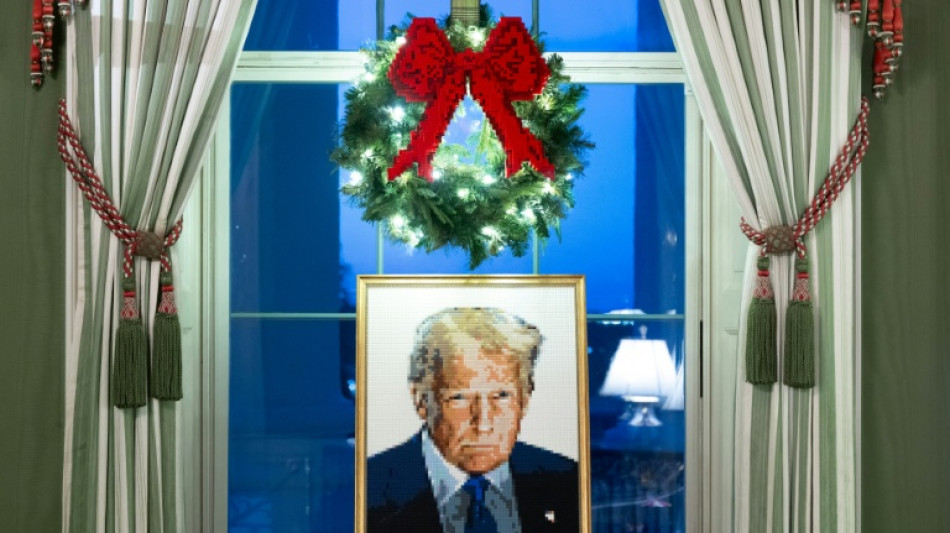
From Honduras to Poland, Trump meddles in elections as never before / Photo: © AFP
The United States has meddled for decades in elections around the world. But no modern president has done so as brazenly as Donald Trump.
Forget shady CIA-hatched plots or surreptitious media campaigns. Trump has openly called on other countries' electorates to vote for his right-wing friends, often deploying his favorite tool of social media.
Most recently, Trump on his Truth Social platform endorsed Honduran right-wing candidate Nasry Asfura as "the only real friend of Freedom" and vowed to work with him. Asfura held a narrow lead after voting Sunday.
"I cannot think of a time when a US president was willing to just openly state his preferences in foreign elections in this way, at least in modern history," said Thomas Carothers, director of the democracy, conflict and governance program at the Carnegie Endowment for International Peace.
Trump has felt especially emboldened in Latin America, where the United States has long intervened.
Trump's secretary of state, Marco Rubio, has belittled Colombia's elected left-wing president, Gustavo Petro, as a "lunatic," and imposed sanctions on a Brazilian judge who prosecuted former far-right president Jair Bolsonaro for trying to overturn election results.
In Argentina, Trump promised $20 billion to prop up the struggling economy but warned it would vanish if voters rejected President Javier Milei in legislative elections. The firebrand libertarian's party ultimately triumphed.
"It's a consistent attempt to influence the politics, to reinforce what I think they see as already a shift towards the right that's gaining force across the region," said Will Freeman, a fellow on Latin America at the Council on Foreign Relations.
In Venezuela, where there is no election to influence, Trump has suggested the use of US military might to remove leftist leader Nicolas Maduro.
- Eye on Europe -
Trump has also sought to tip the scales in Europe. His homeland security chief, Kristi Noem, on a visit to Poland openly endorsed Karol Nawrocki, the conservative candidate for president who went on to win.
Trump had less success in Romania, where a far-right ally lost the presidential election, but only after a previous vote was controversially annulled.
Vice President JD Vance on a trip to Germany publicly attacked restrictions on the far-right AfD party. Trump or his aides have heaped praise on British anti-migrant lawmaker Nigel Farage and criticized a court ruling in France against far-right leader Marine le Pen.
The Trump administration has also stripped back decades of efforts to promote democracy overseas, with Rubio issuing a cable instructing embassies to avoid most commentary on the legitimacy of elections abroad.
The stance mirrors Trump's approach to elections at home. He refused to accept his 2020 loss and was charged with trying to overturn results in the state of Georgia -- a case dropped last week in light of his 2024 election victory.
Trump, perhaps mindful of his own experience, has publicly urged Israel's president to pardon scandal-tainted Prime Minister Benjamin Netanyahu.
- Unique Trump approach -
Ironically, Trump in a speech in Riyadh in May denounced interventionism, at least in the Middle Eastern context, saying that past US efforts had turned into disasters.
Political scientist Dov Levin in a 2021 book found that the United States had intervened in foreign elections more than 80 times since the end of World War II -- more than any other country.
Still, Carothers said that Trump was unique not only in his public methods but in his apparent motivations.
"It's different than during the Cold War when the United States often favored a particular person, but they did so for geostrategic reasons," he said.
"What we have here is more that Donald Trump feels he has a group of friends out there in the world whom he wants to help," he said.
Carothers said that only Russia came close in tactics, with the Kremlin weighing in heavily to make known its preferences in former Soviet bloc countries, such as recently in Moldova where its candidate lost.
"A very high percentage of European leaders would like to see Viktor Orban lose the next election, but they're not going to say so out loud," he said, referring to Hungary's right-wing populist prime minister.
Trump welcomed Orban to the White House last month. Speaking together to reporters, Trump said that European leaders needed to appreciate Orban more.
D.Fischer--NRZ