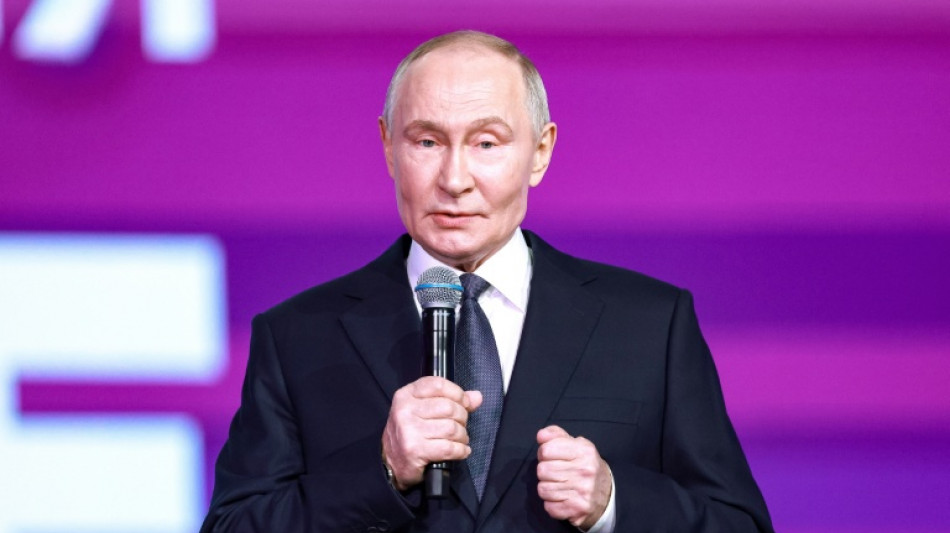
Most EU citizens see 'high risk' of war with Russia: poll / Photo: © POOL/AFP

A majority of citizens across nine EU countries see a high risk of war breaking out between the bloc's members and Russia, according to a survey by polling group Cluster 17 published Thursday in the French international affairs journal Le Grand Continent.
The poll's findings, based on a sample of almost 10,000 people from the nine countries, come more than three-and-a-half years into the conflict sparked by Russia's 2022 full-scale invasion of Ukraine and amid fears the war could spread further.
France's top general Fabien Mandon last month warned Russia was preparing for a new confrontation by 2030. Russian President Vladimir Putin said Tuesday that if Europe wants war "we are ready right now".
The poll showed 51 percent of respondents believe there is a "high" or "very high" risk that Russia could go to war with their country in the coming years. The study was conducted with a sample of 9,553 people at the end of November.
The countries involved in the study were France, Germany, Italy, Spain, Poland, Portugal, Croatia, Belgium and the Netherlands, with samples of more than 1,000 people in each country.
The fear of open conflict with Russia varied.
In Poland, which has borders with Russia and its ally Belarus, 77 percent of respondents considered the risk high or very high.
This figure dropped to 54 percent in France and 51 percent in Germany.
Meanwhile, 65 percent of Italian respondents considered the risk low or nonexistent.
A large majority of 81 percent, meanwhile, said there is little or no chance of a war with China in the coming years.
With a debate intensifying in Europe over military service and France reintroducing a form of voluntary military service, respondents expressed doubt over the capabilities of their armed forces against Moscow.
Sixty-nine percent said their country would be "not at all" or "not likely" capable of defending itself against Russian aggression.
In France -- the only country in the survey to have nuclear weapons -- respondents were the least pessimistic, with 44 percent believing their country is "quite" or "fairly" capable of defending itself.
At the other end of the table were the Belgians, Italians, and Portuguese, who overwhelmingly believe -- at 87 percent, 85 percent and 85 percent respectively -- their countries were incapable of defending themselves.
"Terrorism" remained the most immediate threat in European public opinion. Across the nine countries covered by the survey, 63 percent of respondents considered the risk of open war with "terrorist" groups to be "high" or "very high", according to the poll.
E.K.Friedrich--NRZ